The chatbot era is ending. The next wave of AI applications isn't about conversations — it's about agents that autonomously accomplish goals. We've been building these systems for clients, and the gap between the hype and reality is worth understanding.
What Makes an Agent Different from a Chatbot
A chatbot takes input and produces output. An agent takes a goal, breaks it into steps, selects and uses tools, evaluates results, and adjusts its approach — in a loop. The key difference is autonomy: an agent decides what to do next, not the user.
The core loop is: Observe → Think → Act → Evaluate → Repeat.
The Tool-Use Pattern
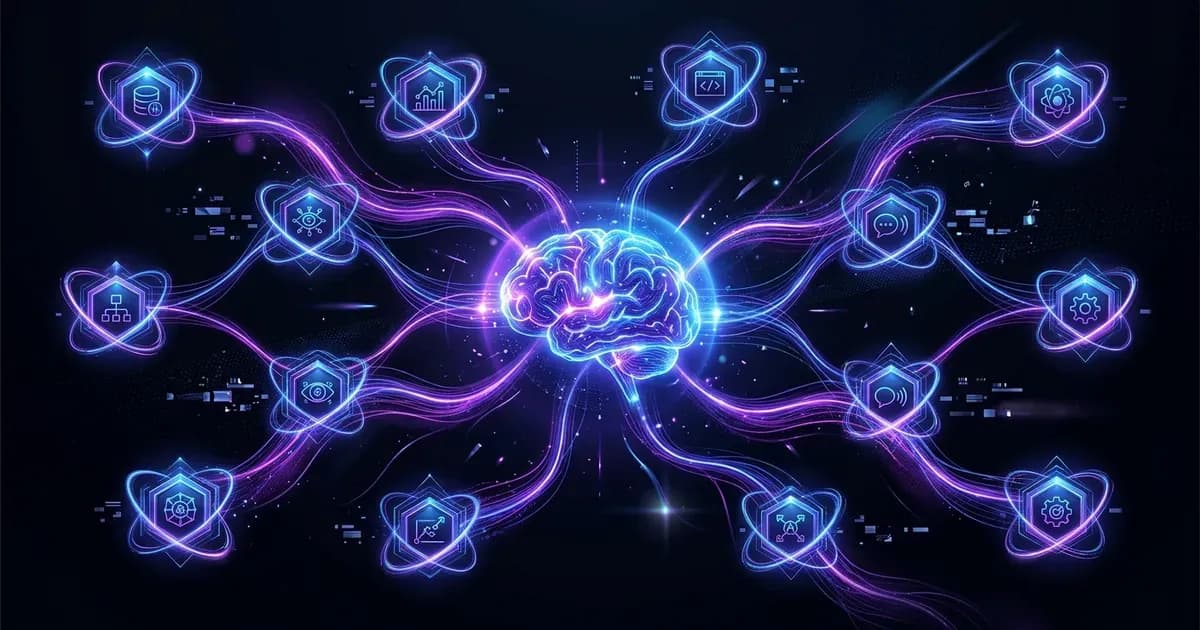
Tools are what make agents useful. A language model alone can only generate text. An agent with tools can query databases, call APIs, execute code, read files, send emails, and interact with any system that has an interface. The model acts as the reasoning engine that decides which tool to use, with what parameters, and how to interpret the result.
Tools we commonly give our agents:
- Database queries (read and write)
- REST/GraphQL API calls to internal and external services
- Code execution in sandboxed environments
- File system operations (read, write, search)
- Web search and content extraction
- Email and messaging (Slack, Teams) for notifications and approvals
Real Agent Applications We've Built
A document processing agent for a legal firm that ingests contracts, extracts key terms, flags non-standard clauses against a policy database, and generates a summary report — handling 200+ documents per day that previously required a paralegal's full attention.
A customer support agent that reads incoming tickets, searches the knowledge base, checks the customer's account status and order history, drafts a response, and either auto-sends (for common issues) or queues for human review (for complex cases). It resolved 40% of tickets without human intervention in the first month.
The Architecture
Our agent stack is straightforward: an LLM (Claude or GPT-4o) for reasoning, a tool registry that maps function names to implementations, a memory system (conversation history plus a vector store for long-term recall), and an orchestrator that manages the observe-think-act loop with guardrails.
We use the Anthropic Agent SDK for Claude-based agents and LangGraph when we need complex multi-agent workflows. For simpler use cases, a hand-rolled loop with structured output parsing is often more maintainable than a framework.
Guardrails Are Not Optional
An autonomous agent without guardrails is a liability. Every production agent we build includes: token budget limits per task, tool call rate limiting, human-in-the-loop checkpoints for high-impact actions (sending emails, modifying data), output validation against expected schemas, and comprehensive logging of every reasoning step and tool call for audit trails.
Where Agents Fall Short
Agents are not magic. They struggle with tasks requiring precise numerical computation, multi-hour planning horizons, and situations where the cost of a wrong action is high and irreversible. They work best when the task is well-defined, the tools are reliable, and there's a clear way to verify success.
The companies getting value from AI agents today aren't replacing entire roles — they're automating the repetitive subtasks within roles, freeing humans to focus on judgment calls that actually require human judgment.